Withdrawal Friction Index 2026: ERC-20 vs TRC-20 vs Layer-2 Networks Across 12 Exchanges
Cheap withdrawals are easy to advertise. Getting your assets out of an exchange, through a functioning network, and into a wallet you control without unexpected delays is a different matter.
Most cryptocurrency exchange comparisons focus on trading fees, liquidity, and supported assets. Yet there is another cost that becomes painfully obvious when you actually want to move money: withdrawal friction.
A USDT withdrawal advertised at $0.50 may appear inexpensive. But what happens if the exchange holds the request for 40 minutes, temporarily suspends the selected network, or requires an additional security review? The network might process transactions in seconds while the exchange itself takes considerably longer to release the funds.
That distinction matters to anyone moving stablecoins between exchanges, transferring profits into self-custody, funding DeFi positions, or executing time-sensitive arbitrage strategies.
In this report, RVCRYP examines the withdrawal economics of 12 major trading venues, including Binance, Coinbase, Kraken, OKX, Bybit, KuCoin, Bitget, MEXC, Gate.io, HTX, Crypto.com, and BingX. We compare available withdrawal-fee disclosures, network availability, and published processing-time benchmarks across Ethereum, Tron, and major Ethereum Layer-2 networks.
- How withdrawal friction differs from ordinary blockchain transaction speed.
- ERC-20, TRC-20, Arbitrum, Optimism, and Base fee comparisons.
- Publicly reported USDT and USDC withdrawal fees across 12 exchanges.
- Why a low withdrawal fee does not necessarily mean a fast withdrawal.
- How to select a network without creating avoidable settlement risk.
- A reproducible framework for calculating an exchange Withdrawal Friction Index.
1. What Is the Withdrawal Friction Index?
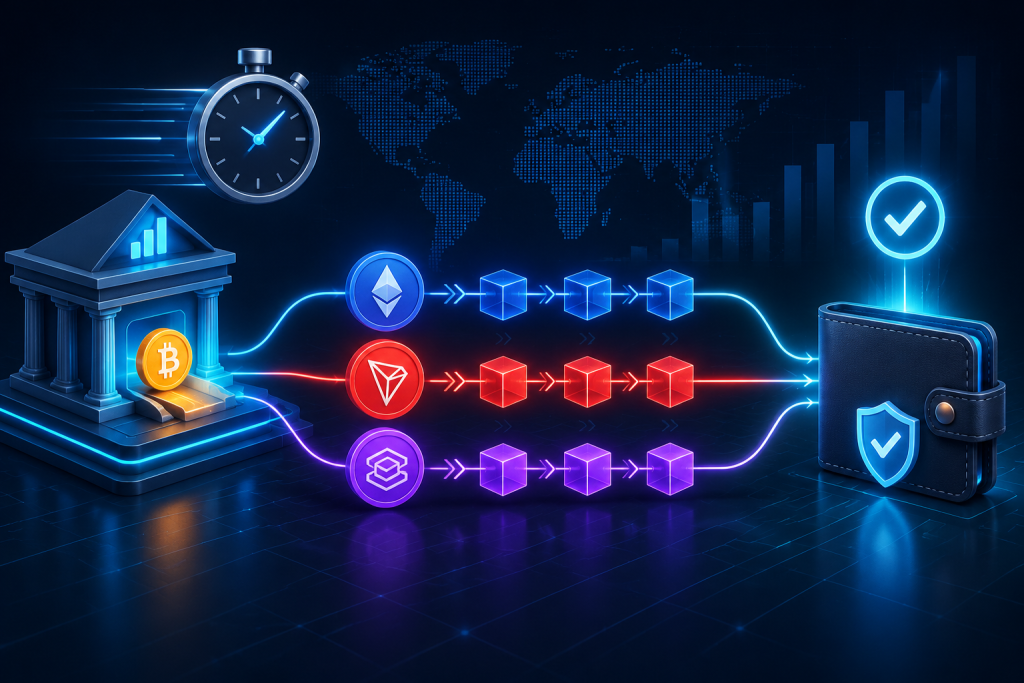
Withdrawal friction is the combined operational and financial cost of moving cryptocurrency out of a centralized exchange.
It is broader than the withdrawal fee displayed on the confirmation screen. A complete assessment must consider how long the exchange takes to approve a request, whether the network is currently available, how many confirmations the receiving platform requires, and whether the transaction reaches a usable final state within a reasonable period.
We separate the problem into five components:
| Component | What It Measures | Why It Matters |
|---|---|---|
| Withdrawal cost | Exchange withdrawal fee and applicable network charge | Determines the direct cost of moving assets. |
| Exchange processing | Time between submitting a request and obtaining a transaction hash | Measures exchange-side operational friction. |
| Network settlement | Time from broadcast to the required confirmation or finality state | Measures blockchain-side performance. |
| Availability | Whether deposits and withdrawals are enabled for the selected asset-network pair | A cheap network is useless if withdrawals are suspended. |
| Exception handling | Additional KYC, security reviews, failed requests, and manual intervention | Captures problems that ordinary fee tables miss. |
The distinction between processing and settlement is particularly important. Suppose an exchange takes 15 minutes to approve a withdrawal and the blockchain confirms the transaction in 30 seconds. Reporting that withdrawal as a 30-second transaction would be technically misleading from the user’s perspective.
2. ERC-20 vs TRC-20 vs Layer-2: Where Does the Friction Come From?
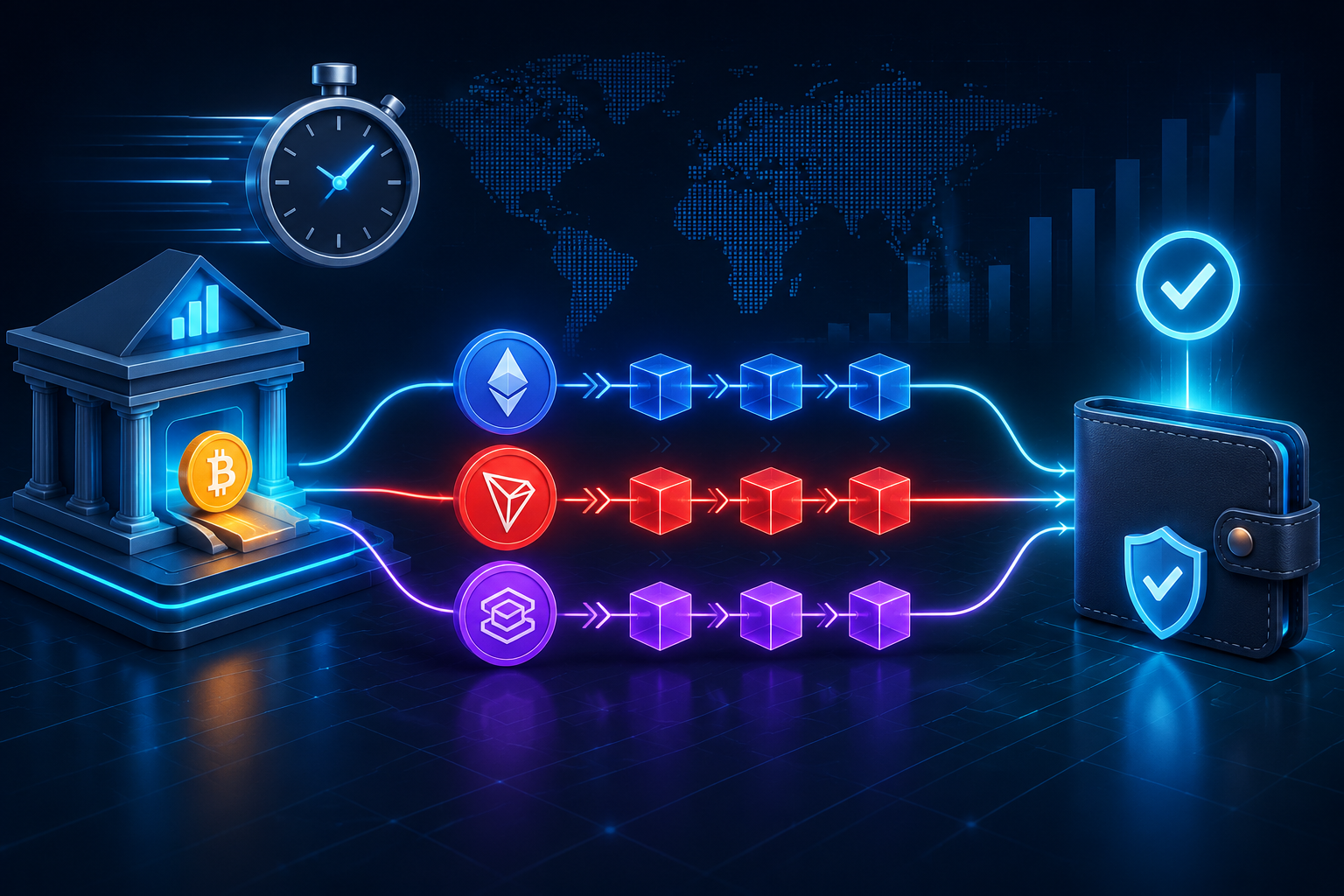
These networks are not interchangeable payment rails. They have different security models, fee structures, settlement processes, and exchange integration requirements.
Ethereum ERC-20: Established infrastructure, variable cost
ERC-20 is the token standard used by many assets on Ethereum. USDT and USDC transfers on Ethereum benefit from a mature ecosystem and broad wallet and exchange support.
The trade-off is that Ethereum mainnet transaction fees fluctuate with network demand. Users may face higher costs during busy periods, especially when an exchange applies a fixed withdrawal charge rather than passing through the exact transaction cost.
Ethereum also has a distinction between transaction inclusion and economic finality. A transaction appearing in a block does not mean every application or receiving exchange considers it fully settled. Ethereum’s proof-of-stake finality mechanism operates through checkpoint justification and finalization, rather than a simple universal number of confirmations.
Best suited for: Users prioritizing broad compatibility, established infrastructure, and direct Ethereum ecosystem access rather than the lowest possible transfer cost.
Tron TRC-20: Popular for stablecoin transfers
Tron has become a major route for USDT transfers, particularly for users who regularly move stablecoins between exchanges and personal wallets.
Its transaction economics differ from Ethereum. Tron uses bandwidth and energy resources, and the practical cost of a transfer depends on account resources and transaction conditions. Exchanges generally simplify this process by displaying a fixed withdrawal charge.
However, low network-level friction does not guarantee low exchange-level friction. A platform may batch withdrawals, impose internal risk checks, or suspend TRC-20 withdrawals temporarily while maintaining trading services.
Best suited for: Frequent USDT transfers where both the sending and receiving platforms explicitly support the TRC-20 version of the asset.
Arbitrum, Optimism and Base: Lower-cost Ethereum-compatible routes
Layer-2 networks process transactions outside Ethereum mainnet execution while using Ethereum as part of their security and settlement architecture.
Arbitrum, Optimism, and Base can offer substantially lower transfer costs than Ethereum mainnet. They also support Ethereum-compatible applications and token standards, making them convenient for users operating within the Ethereum ecosystem.
But there is a technical detail that often gets overlooked: a fast Layer-2 transaction is not necessarily equivalent to a fully finalized Ethereum mainnet withdrawal.
Rollups have their own transaction inclusion, sequencing, proof or challenge processes, and settlement relationships with Ethereum. For ordinary exchange deposits, the receiving exchange may credit assets after its own confirmation policy is satisfied. For cross-chain bridging or high-value settlement, the security and finality requirements can be different.
Gemini’s multichain documentation, for example, distinguishes ordinary transfer completion from the potential finalization period of Layer-2 deposits, noting that some L2 deposits may not be fully finalized for up to seven days.
Best suited for: Users transferring compatible assets between platforms that explicitly support the same L2 network, particularly when fees and transaction speed matter.
| Network | Primary Advantage | Main Trade-Off | Typical Use Case |
|---|---|---|---|
| Ethereum ERC-20 | Broad compatibility and mature infrastructure | Variable network costs | Large transfers and Ethereum ecosystem access |
| Tron TRC-20 | Popular USDT transfer route | Asset and exchange support must be checked | Routine stablecoin transfers |
| Arbitrum | Low-cost Ethereum-compatible transactions | Exchange support and finality policies vary | L2 exchange transfers and DeFi |
| Optimism | Lower-cost Ethereum ecosystem access | Exchange-specific availability | Supported L2 transfers |
| Base | Low-cost transactions and growing ecosystem | Not every exchange supports every asset | USDC transfers and Base applications |
3. The 12-Exchange Withdrawal Fee Benchmark
Withdrawal fees are among the easiest components of friction to compare because exchanges publish their charges directly or display them before confirmation.
For this comparison, we use a public fee snapshot dated November 3, 2026, covering major stablecoin withdrawal routes. The table below focuses on USDT and USDC because stablecoins are frequently used for exchange-to-exchange transfers.
The figures are converted to USD and represent published or observed withdrawal charges, not a guarantee of the fee available to every account or jurisdiction.
Exchange coverage
| Exchange | Included in Comparison | Relevant Research Dimension |
|---|---|---|
| Binance | Yes | Multi-network stablecoin withdrawals |
| BingX | Yes | Network availability and fees |
| Bitget | Yes | Multi-chain withdrawal pricing |
| Bybit | Yes | Stablecoin network support |
| Coinbase | Yes | Ethereum and L2 withdrawal options |
| Crypto.com | Yes | Network-specific withdrawal charges |
| Gate.io | Yes | Broad asset and network coverage |
| HTX | Yes | Multi-network withdrawal pricing |
| Kraken | Yes | Withdrawal cost and supported routes |
| KuCoin | Yes | Network-dependent withdrawal charges |
| MEXC | Yes | Low-cost alternative network routes |
| OKX | Yes | Multi-chain stablecoin withdrawals |
Sources: Orbital Research, public exchange withdrawal-fee comparison, October 2026 withdrawal activity and November 3, 2026 fee snapshot. The exchange coverage reflects the 12 named venues in the comparison universe. Not every exchange publishes or supports every asset-network combination.
USDT withdrawal fees: Tron versus Ethereum and L2
The following examples show why network selection can have a meaningful effect on the cost of transferring stablecoins.
| Exchange | USDT TRC-20 | USDT ERC-20 | USDT Arbitrum |
|---|---|---|---|
| Binance | $4.00 | $0.60 | Paused |
| BingX | $1.50 | $1.00 | $0.80 |
| Bitget | $1.50 | $2.00 | $0.07 |
| Bybit | $1.30 | $0.80 | $0.07 |
| Gate.io | $1.50 | $1.00 | $0.05 |
| HTX | $1.20 | $0.30 | Paused |
| KuCoin | $1.99 | $5.50 minimum | $0.80 |
| MEXC | $1.20 | $0.30 | $0.05 |
| OKX | $1.50 | $0.50 | $0.0095 |
Sources: Orbital Research, USDT withdrawal fees by exchange, snapshot dated November 3, 2026. Fees shown in USD. Paused means the route was listed but unavailable for withdrawals in the source snapshot. These figures are historical observations, not live quotes. Always check the withdrawal confirmation screen before submitting a transaction.
Several results stand out.
First, Tron is not automatically the cheapest option. Binance’s recorded $4.00 TRC-20 fee was substantially higher than its $0.60 Ethereum fee in this particular snapshot. The same pattern appears at other exchanges, although the direction and magnitude differ.
Second, Layer-2 routes can be dramatically cheaper. OKX’s listed Arbitrum USDT charge was just $0.0095, while MEXC and Gate.io listed $0.05. Bybit listed $0.07.
Third, availability is part of the cost. A route marked as paused cannot be treated as a cheap alternative simply because its published fee looks attractive.
USDC withdrawal fees: The L2 advantage
USDC offers another useful comparison because major exchanges increasingly support it across Ethereum-compatible networks.
| Exchange | USDC Base | USDC Arbitrum | USDC Optimism |
|---|---|---|---|
| Binance | Paused | $0.30 | Paused |
| BingX | Paused | $0.50 | Paused |
| Bitget | $0.10 | $0.10 | $0.10 |
| Bybit | $0.25 | $0.10 | Paused |
| Crypto.com | $0.03 | $1.18 | Not listed |
| Gate.io | $0.05 | $0.05 | $0.05 |
| HTX | $2.60 | Paused | Paused |
| KuCoin | $0.50 | $1.00 | Not listed |
| MEXC | $0.10 | $0.05 | $0.0048 |
| OKX | $0.02 | $0.0033 | Not listed |
Sources: Orbital Research, USDC withdrawal-fee comparison, November 3, 2026 snapshot. Not listed means the source did not provide a comparable route; paused indicates a listed but suspended route. Fee availability can change by region and account.
There is an important practical lesson here: choosing the right asset and network combination can matter more than choosing the cheapest exchange in isolation.
For example, a user transferring USDC from OKX to another platform that accepts USDC on Arbitrum may face a very different direct withdrawal cost from someone transferring USDT over Tron. Comparing exchanges without specifying the asset and network produces misleading conclusions.
4. How Long Do Withdrawals Actually Take?
Fees are only half the story. A cheap transfer that takes an hour to become available can be more expensive in practical terms than a slightly higher-fee route that settles predictably.
One publicly available USDC withdrawal-time benchmark, published by Eco and reflecting typical conditions in May 2026, provides useful indicative ranges across Ethereum, Base, Arbitrum, Optimism, Polygon, and other networks.
| Network | Published Typical Range | Operational Interpretation |
|---|---|---|
| Base | Under 1 to 5 minutes | Fast L2 transfer under ordinary conditions |
| Arbitrum | 1 to 5 minutes | Usually quick for ordinary exchange transfers |
| Optimism | 1 to 5 minutes | Usually quick when both platforms support the route |
| Ethereum | 5 to 20 minutes | More dependent on exchange confirmation requirements |
| Polygon | 2 to 7 minutes | Depends on platform processing and confirmation policy |
| Avalanche | 1 to 2 minutes | Separate network, not an Ethereum L2 |
Sources: Eco Help Center, USDC Withdrawal Times by Network, published October 2026, with typical timing ranges reflecting May 2026 conditions. These are indicative third-party observations, not a synchronized RVCRYP test of all 12 exchanges. Actual times depend on exchange queues, network conditions, and receiving-platform confirmation requirements.
The ranges should not be interpreted as guarantees. They are useful planning references, not service-level agreements.
Why Ethereum can be slower even when the transaction is already confirmed
A withdrawal may pass through several stages:
- Stage 1 — Request submission: The user confirms the amount, destination address, and withdrawal network.
- Stage 2 — Exchange review: Automated systems or manual compliance checks evaluate the request.
- Stage 3 — Transaction broadcast: The exchange signs and broadcasts the transaction, producing a transaction hash.
- Stage 4 — Network inclusion: The blockchain includes the transaction in a block.
- Stage 5 — Receiving-platform credit: The destination exchange waits for its own required confirmations before making the balance available.
A transaction hash is evidence that a withdrawal has been broadcast. It is not proof that the destination exchange has credited the funds.
5. Network Availability: The Hidden Withdrawal Cost
One of the most overlooked aspects of exchange comparisons is the difference between a supported network and an operationally available network.
An exchange may technically support USDT on Arbitrum, but that does not mean withdrawals are always enabled. Maintenance, wallet infrastructure changes, liquidity management, security incidents, and compliance requirements can temporarily affect individual asset-network combinations.
A public withdrawal-status tracker covering 24 exchanges and 24,488 assets reported 17,599 paused asset-network pairs as of November 25, 2026, at 04:50 UTC.
This number needs context: the tracker includes a broad range of assets and networks, including dormant or less-used combinations. It should not be interpreted as 17,599 suspended major stablecoin withdrawal routes.
However, it demonstrates why checking current availability is essential before treating a network as a reliable withdrawal option.
For users, the practical checklist is straightforward:
- Confirm that the exact asset is supported on the sending network.
- Confirm that the receiving platform supports the same asset-network combination.
- Check whether deposits and withdrawals are both enabled.
- Verify the minimum withdrawal amount and fee.
- Check for network maintenance notices before sending a time-sensitive transfer.
Sources: ByKaranteli, public withdrawal status and network fee tracker, data observed November 25, 2026. Tracker coverage: 24 venues and 24,488 assets. Status figures are a broad market snapshot, not an exchange-specific failure rate.
6. Building a More Useful Withdrawal Friction Index
A meaningful index should not simply rank exchanges by the lowest withdrawal fee. That approach rewards platforms that offer cheap transfers but ignores processing delays, suspended networks, and unpredictable exception handling.
For a standardized RVCRYP benchmark, we propose the following scoring framework.
| Dimension | Weight | Measurement |
|---|---|---|
| Direct withdrawal cost | 25% | Normalized fee for the same asset and network |
| Exchange processing latency | 25% | Submission-to-transaction-hash time |
| End-to-end settlement | 25% | Submission-to-usable-balance time |
| Network availability | 15% | Availability of the required asset-network route |
| Operational consistency | 10% | Variation, exceptions, and reproducibility across repeated tests |
Each dimension receives a normalized score from 0 to 100, with a higher score representing lower friction. The weighted result is calculated as follows:
WFI = (Cost Score × 0.25) + (Processing Score × 0.25) + (Settlement Score × 0.25) + (Availability Score × 0.15) + (Consistency Score × 0.10)
A higher WFI score means a smoother withdrawal experience. It does not represent a guarantee of withdrawal approval or asset safety.
The key is to normalize each metric within the same asset-network test group. Comparing an Ethereum withdrawal against a Base withdrawal without accounting for the different network conditions would distort the results.
How a proper 12-exchange stopwatch test should work
To turn this framework into an independently verified exchange ranking, the test should control the variables that influence withdrawal performance.
- Use the same asset: Test USDT or USDC separately. Never combine the results into one unqualified average.
- Use identical networks: Compare exchanges only where the same asset-network route is supported.
- Standardize transfer size: Use a fixed amount that exceeds minimum withdrawal limits without triggering unusual high-value review thresholds.
- Synchronize the observation window: Run tests during the same market conditions and record UTC timestamps.
- Record every stage: Capture request submission, approval, transaction hash, first confirmation, required confirmations, and final destination credit.
- Repeat the test: Use multiple trials across different time windows to avoid drawing conclusions from one unusually fast or slow transaction.
- Document exceptions: Record failed requests, maintenance periods, additional KYC checks, and manually reviewed withdrawals.
A useful test dataset should contain the exchange, asset, network, amount, fee, request timestamp, broadcast timestamp, transaction hash, confirmation timestamp, destination-credit timestamp, and final status.
Until this dataset is collected, exchange-specific latency scores should remain unassigned rather than being estimated from network averages.
7. Three Real-World Withdrawal Scenarios
Different users experience withdrawal friction differently. The best route for an arbitrage trader may not be the best route for someone transferring savings into cold storage.
Scenario A: Moving $1,000 in USDT between exchanges
Suppose you want to move $1,000 in USDT from Exchange A to Exchange B.
If both exchanges support TRC-20 and the sending platform charges $1.20, the direct fee is $1.20. If the receiving platform does not support TRC-20, however, the route is not viable regardless of its price.
Now assume the same transfer is available through Arbitrum for $0.05. The direct saving is $1.15 per transfer.
For someone making 20 transfers per month, that difference becomes $23. But it only represents a genuine saving if both endpoints support the same token and network and the destination credits the deposit correctly.
Scenario B: Executing time-sensitive arbitrage
For arbitrage traders, withdrawal latency can matter more than the nominal network fee.
Imagine a price discrepancy worth $80 between two exchanges. A $1 withdrawal fee is not the main problem if the transfer takes 45 minutes and the pricing opportunity disappears after five.
The relevant performance measure is not the blockchain’s advertised block time. It is the complete operational time from withdrawal request to usable funds on the destination platform.
Professional operators should also account for exchange-specific deposit confirmation requirements and the possibility of withdrawal queues during periods of elevated market activity.
Scenario C: Moving funds into self-custody
For long-term holders, the priorities are different.
Network compatibility, address accuracy, operational reliability, and the security model of the receiving wallet matter more than saving a few cents.
Before sending a large amount, confirm that the wallet supports the exact token and network. For a new destination address, a small test transfer is a sensible precaution.
Remember that an Ethereum address format may look identical across several EVM-compatible networks. That does not mean the assets are interchangeable or that the receiving application automatically supports every network.
8. Common Withdrawal Mistakes That Create Unnecessary Friction
Choosing a network based only on the fee
The cheapest route is not automatically the best route. A withdrawal should be evaluated against the destination platform’s supported networks and crediting policy.
Confusing transaction speed with exchange processing speed
Blockchain confirmation time starts after broadcast. It does not include the time an exchange spends reviewing and preparing the withdrawal.
Ignoring paused withdrawal routes
A listed network does not guarantee that withdrawals are currently available. Always verify live status before committing to a transfer.
Assuming all USDT or USDC tokens are identical across networks
The asset name alone is not sufficient. USDT on Ethereum and USDT on Tron are issued and represented through different network contracts and cannot simply be sent to an arbitrary address on another network.
Making a second withdrawal when the first is pending
Check the original transaction status first. A pending exchange review and an unconfirmed blockchain transaction are two different problems that require different responses.
9. What This Means for Exchange Selection in 2026
Our comparison highlights a broader issue in centralized exchange evaluation: withdrawal quality should be treated as a core operational metric, not an afterthought.
Binance, OKX, Bybit, Kraken, Coinbase, and the other major platforms have different network integrations, fee policies, and compliance procedures. No single exchange should be assumed to have the lowest friction for every asset and every destination.
Users should compare the exact transfer they intend to make rather than relying on a universal ranking.
For example:
- Frequent stablecoin transfers require competitive fees and reliable network availability.
- Large-value withdrawals require greater attention to security reviews, account restrictions, and receiving-platform confirmation rules.
- Arbitrage strategies require predictable end-to-end settlement, not simply fast block production.
- Self-custody withdrawals require accurate network selection and wallet compatibility.
For broader exchange risk and fee analysis, see the RVCRYP Exchange Comparisons research hub. You can also explore our Binance vs. MEXC 2026 slippage and listing-speed analysis for a closer look at the relationship between trading execution and operational efficiency.
10. Final Verdict: The Cheapest Withdrawal Is Not Always the Best Withdrawal
What Users Should Take Away
The most important finding from this comparison is that withdrawal costs cannot be evaluated independently of exchange processing, network availability, and destination-platform crediting policies.
Layer-2 networks can offer exceptionally low withdrawal fees. Tron remains an important stablecoin transfer route. Ethereum continues to provide broad compatibility and mature infrastructure. But the right choice depends on the exact asset, the exchange pair, and the operational conditions at the time of transfer.
For users, the most reliable approach is to compare the complete withdrawal journey rather than focusing on one advertised fee or one blockchain confirmation metric.
At RVCRYP, our broader exchange research framework evaluates security, liquidity, regulatory exposure, trading costs, and operational reliability together. Withdrawal performance deserves the same level of scrutiny because access to your assets is ultimately what matters.
Sources and Research Methodology
The figures and observations in this report are drawn from the following public research and documentation. Historical fee observations are identified separately from network-level timing guidance.
- Orbital Research — USDT and USDC Exchange Withdrawal Fees. Public exchange fee comparison using October 2026 withdrawal activity and November 3, 2026 fee observations.
- Eco Help Center — USDC Withdrawal Times by Network. Published typical transfer-time ranges reflecting May 2026 conditions.
- ByKaranteli — Withdrawal Status and Network Fees. Exchange network availability and historical status tracking, snapshot referenced November 25, 2026.
- Gemini — Multichain ETH, USDC, RLUSD and USDT. Official documentation covering supported networks and the distinction between transfer completion and L2 finalization.
- Ethereum.org — Proof-of-Stake Consensus. Technical background on Ethereum finality.
- Ethereum.org — Optimistic Rollups. Background on L2 settlement and security models.
Methodological limitations: Exchange withdrawal fees and network availability change frequently. Published timing ranges are not guaranteed service levels. This report does not claim a completed synchronized 12-exchange latency experiment. A future exchange-specific WFI ranking requires timestamped withdrawal trials, repeated observations, and independently verifiable transaction records. Figures should be rechecked before being used for financial decisions.
Frequently Asked Questions
1. Which network is cheapest for USDT withdrawals in 2026?
There is no universally cheapest network. The November 3, 2026 fee snapshot showed that certain Arbitrum routes were priced as low as $0.05 or less, while some Tron withdrawals cost more than $1. The cheapest option depends on the exchange and the asset-network combination.
2. Is TRC-20 faster than ERC-20?
Tron and Ethereum have different block-production and settlement mechanisms. TRC-20 transfers can be convenient for stablecoin payments, but actual withdrawal completion also depends on exchange processing and the receiving platform’s confirmation requirements.
3. Are Arbitrum and Optimism faster than Ethereum?
For ordinary transactions, both generally provide faster and cheaper execution than Ethereum mainnet. However, L2 transaction inclusion, rollup settlement, and final Ethereum-level finality are different stages.
4. Why is my crypto withdrawal still pending after the exchange approved it?
The exchange may have approved the request without the transaction being broadcast or sufficiently confirmed. Check whether a transaction hash is available, inspect its status using the relevant network explorer, and review the receiving exchange’s deposit confirmation policy.
5. Does a low withdrawal fee mean an exchange is better?
No. A useful exchange comparison must also consider processing delays, network availability, account security reviews, deposit confirmation requirements, and operational consistency.
6. Can I send ERC-20 USDT to a TRC-20 deposit address?
No. You must use the exact network supported by the destination platform. Sending an asset through an unsupported network can result in delayed recovery or permanent loss of funds.
7. How should I measure the real withdrawal time of an exchange?
Record the timestamp when the withdrawal is submitted, when the exchange broadcasts it, when the blockchain confirms it, and when the receiving platform credits the balance. The complete interval is more useful to users than blockchain confirmation time alone.
Editorial note: This report is for informational and comparative research purposes only. Network fees, supported assets, withdrawal availability, and confirmation requirements may change without notice. Always verify current conditions directly with the sending and receiving platforms.
